Home › What’s covered › Shape Shore
Shape Shore
Shape Shore covers geometry: right angles and turns, kinds of lines, naming and sorting shapes, symmetry and coordinates, then angle facts, circles and transformations in Years 5 and 6.
Every question comes with a clear drawing, and answers are often a tap on a choice rather than typing.
Years 3 and 4: getting started
The Year 3 and 4 skills. Younger children start here, and older children can use them for a recap.
Right angles and turns
A right angle is a quarter turn, like the corner of a book. 4 right angles make a whole turn.
- more or less than a right angle
- quarter, half and whole turns
- turning and directions
Horizontal, vertical, parallel and perpendicular
Horizontal is flat like the horizon. Vertical goes straight up. Parallel lines never meet. Perpendicular lines meet at a right angle.
- horizontal or vertical
- parallel or perpendicular
Naming 2D and 3D shapes
2D shapes are flat. 3D shapes are solid, with faces, edges and corners.
- name the shape
- how many sides?
- 3D shapes
Sorting triangles and quadrilaterals
Triangles: equilateral, isosceles, scalene, right-angled. Quadrilaterals: square, rectangle, rhombus, parallelogram, trapezium.
- kinds of triangle
- kinds of quadrilateral
- right-angled triangles
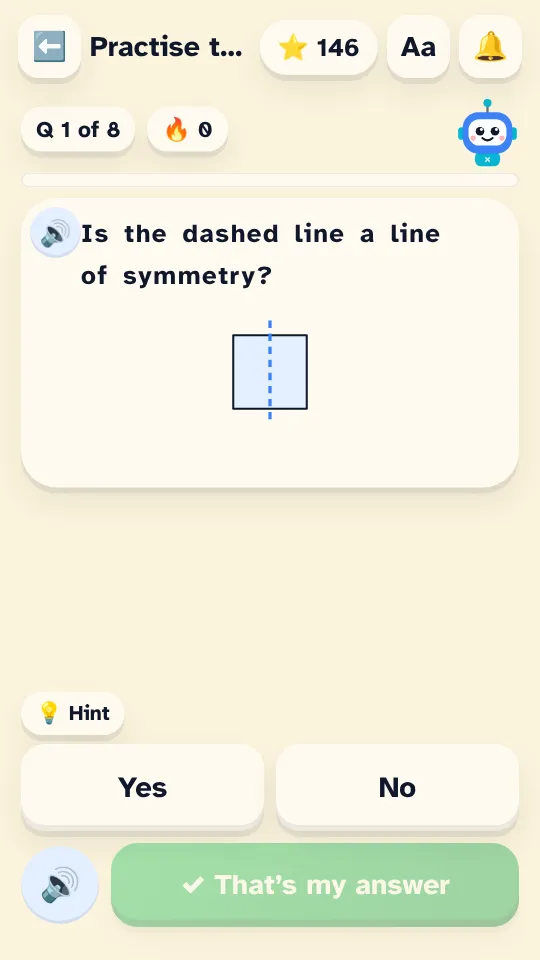
Lines of symmetry
A line of symmetry is a mirror line. Fold along it and both halves match exactly.
- is it a line of symmetry?
- how many lines?
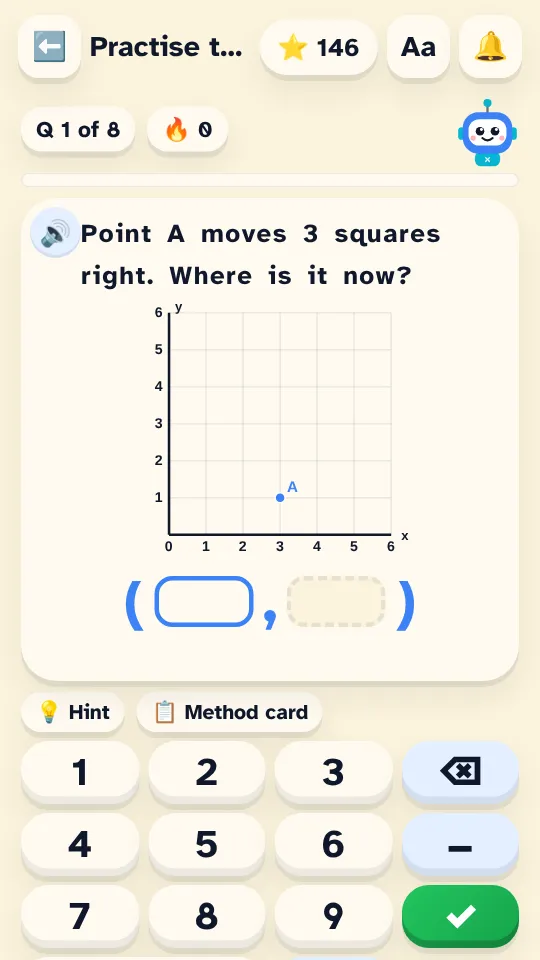
Coordinates and moving shapes
Coordinates say where a point is: first along (x), then up (y). Translate means slide.
- read a point
- which point?
- slide a point
Years 5 and 6: next steps
The Year 5 and 6 skills, building up to the KS2 SATs.
Types of angle
Acute is less than 90°. A right angle is exactly 90°. Obtuse is between 90° and 180°. Reflex is more than 180°.
- from a picture
- from a number
Missing angles: lines and points
Angles on a straight line add up to 180°. Angles around a point add up to 360°.
- on a straight line
- around a point
- crossing lines
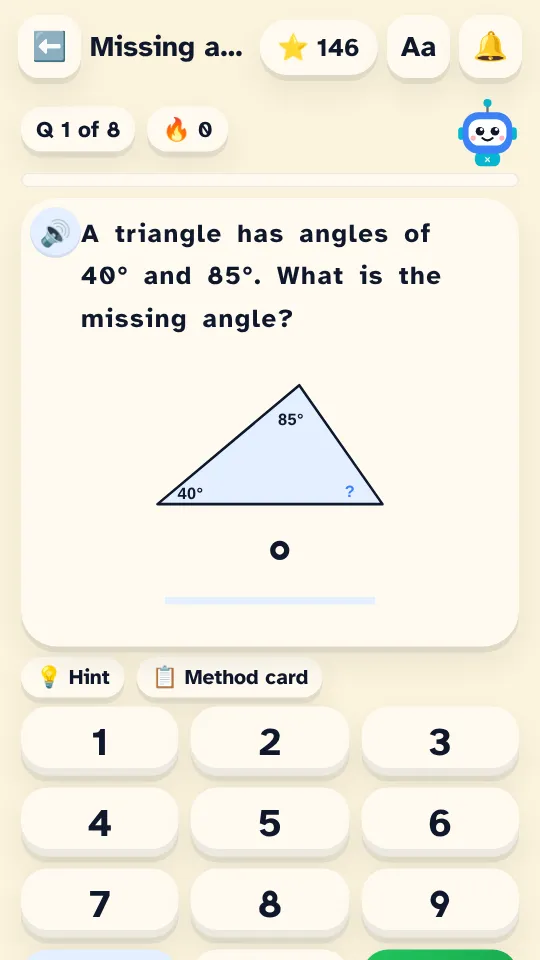
Missing angles in shapes
The angles in a triangle add up to 180°. The angles in a quadrilateral add up to 360°.
- triangles
- isosceles triangles
- quadrilaterals
2D shapes and their properties
Know your shapes: how many sides, which sides are parallel, and which angles are right angles.
- quadrilaterals
- types of triangle
- names of polygons
- lines of symmetry
3D shapes
Faces are the flat sides. Edges are where two faces meet. Vertices are the corners.
- faces, edges and vertices
- which shape?
Circles: radius and diameter
The radius goes from the centre to the edge. The diameter goes all the way across. Diameter = 2 × radius.
- radius → diameter
- diameter → radius
Coordinates
Along the corridor, then up (or down) the stairs. The x number comes first.
- reading points
- all four quadrants
- missing corner
Translation and reflection
Translate means slide. Reflect means flip in a mirror line.
- translating a point
- reflecting a point
Shape problems
Word problems about shapes and angles. Use Break it down to plan.
- regular shapes
- isosceles angles
- square: perimeter to area
- angles at a point
How Shape Shore works
- A short, no-pressure quick check finds the right starting point. It isn’t a test.
- Every question can be read aloud, and hints show a picture first.
- Each level has its own boss battle, unlocked once your child has had plenty of practice.
- Practice is untimed.