Home › What’s covered › Fraction Forest
Fraction Forest
Fraction Forest covers fractions, decimals and percentages, starting with tenths and shaded shapes in Year 3 and building up to comparing, simplifying and converting in Year 6.
Pictures lead the way: shaded shapes, fraction bars and number lines help children see what a fraction means before working with the numbers.
Years 3 and 4: getting started
The Year 3 and 4 skills. Younger children start here, and older children can use them for a recap.
Tenths
Split one whole into 10 equal parts. Each part is one tenth, 1/10.
- tenths on a number line
- count in tenths
- 1/10 of a number
Fractions of shapes and amounts
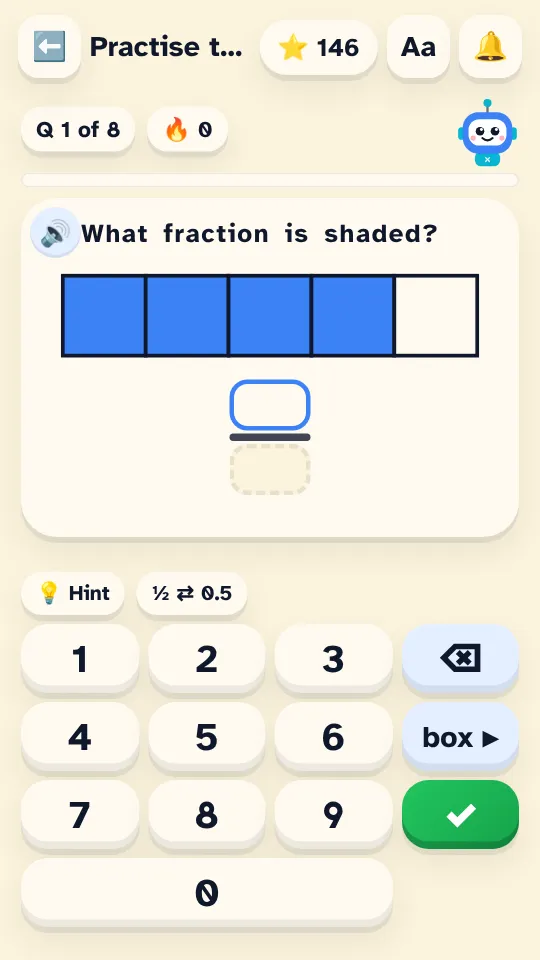
The bottom number says how many equal parts. The top number says how many you have.
- what fraction is shaded?
- 1/4 of 20, and more
- 3/4 of 12, and more
Adding fractions within one whole
When the bottom numbers are the same, add or take away the top numbers.
- adding
- taking away
- the same amount
Hundredths and decimals
1/10 = 0.1 and 1/100 = 0.01. Dividing by 10 or 100 moves the digits to the right.
- tenths as decimals
- hundredths as decimals
- ÷ 10 and ÷ 100
- halves and quarters
Rounding decimals to whole numbers
Look at the tenths. 5 or more: round up. 4 or less: stay the same.
- to the nearest whole number
- exactly halfway
- which is bigger?
Years 5 and 6: next steps
The Year 5 and 6 skills, building up to the KS2 SATs.
Fractions on a number line
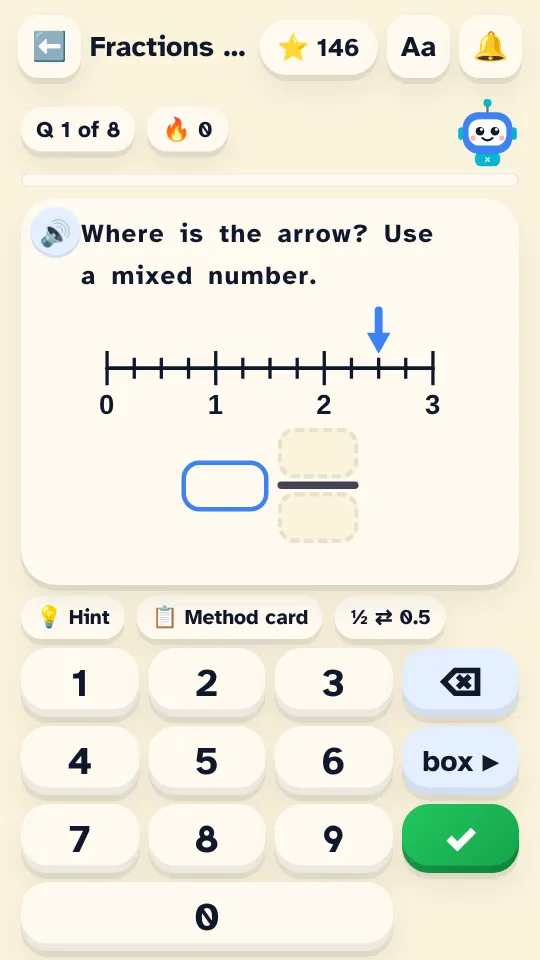
Count the jumps. How many parts make one whole? That is the bottom number.
- between 0 and 1
- decimals in tenths
- past 1
Equivalent fractions
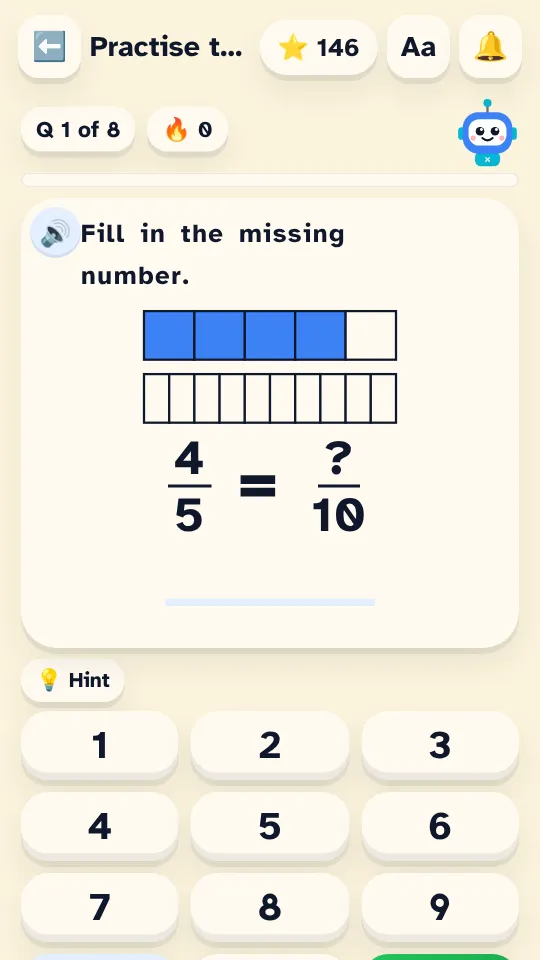
Equivalent fractions are the same amount. Multiply or divide the top and bottom by the same number.
- find the top number
- find the bottom number
- divide down
Simplifying fractions
Divide the top and bottom by the same number until you can’t any more.
- smaller numbers
- bigger numbers
Improper fractions and mixed numbers
An improper fraction has a top number bigger than the bottom. A mixed number has wholes and a fraction.
- improper → mixed
- mixed → improper
Comparing and ordering fractions
Which fraction is bigger? Same bottom numbers make it easy. If not, make them the same.
- same bottom number
- same top number
- different bottoms
- smallest or biggest of three
Decimal place value
Each place is 10 times smaller as you go right: ones, tenths, hundredths, thousandths.
- value of a decimal digit
- value of a digit in big numbers
- put the parts together
Rounding
Look at the next digit. 5 or more: round up. 4 or less: stay the same.
- whole numbers
- decimals
Comparing and ordering decimals
Line up the decimal points. Longer numbers are not always bigger!
- which is bigger
- smallest or biggest of three
Fractions and decimals
Change fractions into decimals and back again. Tenths and hundredths are the key.
- fraction → decimal
- decimal → fraction
- tenths and hundredths
Percentages, fractions and decimals
Percent means "out of 100". Move between percentages, decimals and fractions.
- decimal → %
- fraction → %
- % → decimal
- % → fraction
How Fraction Forest works
- A short, no-pressure quick check finds the right starting point. It isn’t a test.
- Every question can be read aloud, and hints show a picture first.
- Each level has its own boss battle, unlocked once your child has had plenty of practice.
- Practice is untimed.